.png?width=50&height=50&name=Logo_Watermart_Perkasa-removebg-preview%20(1).png)
Drinking water that looks clear is not necessarily safe, and water that tastes "good" is not necessarily stable every day. Therefore, you need a clear way to test the quality of drinking water, both for home use, and for foodservice businesses such as cafes, restaurants, caterers, bakeries, and production kitchens. When you test properly, you get data. Then, when you use the data, you can maintain the taste, cleanliness, and performance of your equipment.
In the field, water problems often appear in simple forms: ice cubes smell, coffee changes flavor, tea tastes "astringent", the kettle crusts quickly, or dishes are stained after washing. However, the root of the problem remains the same: a water parameter has shifted. So, you need to test the right parameters, use the right sampling method, and then establish consistent actions.
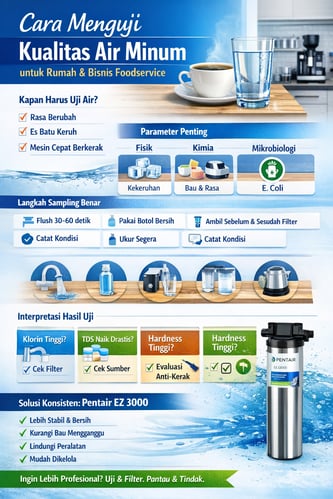
1) When do you need to test drinking water quality?
You don't need to wait for complaints. Instead, you need to test when there are the following signs:
- The taste of the drink changes from day to day.
- Ice cubes are cloudy, smelly, or melt quickly.
- Coffee machine, steamer, kettle, or dispenser crusts quickly.
- Water smells of chlorine, earthy odor, or metallic odor.
- Water leaves yellow, red, or black stains on sinks and glasses.
- You just installed a new filter, replaced the cartridge, or moved the outlet location.
- The rainy season is coming, or the well flow has changed.
For businesses, you also need regular testing because consistent quality affects repeat orders. In addition, stable water quality reduces service costs and downtime.
2) Parameters you must check (home and business)
To keep your testing to a minimum, you focus on the parameters that most often trigger taste, safety, and scale issues.
A. Physical parameters
- Turbidity (Turbidity/NTU)
Turbidity indicates fine particles. If turbidity is high, filters get dirty quickly, beverage flavors are often unstable, and system sanitization can be more difficult. - Color, odor, and taste (organoleptic test)
A yellowish color often appears due to iron or organics. Chlorine odor often comes from chlorine. Earthy odors can be related to organics or microbial growth in the reservoir/pipe. - Temperature
Temperature affects the taste and scale formation process, especially in heaters and boilers.
B. Chemical parameters
- pH
Too low a pH can accelerate corrosion and create a "sharp" taste. Too high a pH can accelerate scaling under certain conditions. - TDS (Total Dissolved Solids)
TDS affects the taste and gives an idea of the amount of solute. However, TDS does not tell you the type of substance, so you still need other parameters. - Hardness (Ca/Mg hardness)
High hardness accelerates scale in kettles, coffee machines, steamers, and water heaters. Therefore, hardness is a key indicator for appliance protection. - Chlorine (free/total chlorine)
Chlorine aids in the disinfection of tap water, but it can also interfere with the taste of coffee and tea. In addition, chlorine that "bleeds through" after carbon filtration indicates that the media capacity has decreased or the flow rate is too high. - Iron (Fe) and Manganese (Mn)
Fe and Mn trigger stains, odors, and sediment. If you are using a borehole well, these parameters are often the main cause of "yellow" or "metallic smelling" water. - Nitrate/Nitrite
This parameter is important for safety, especially for families with babies, and relevant for locations with a risk of surface contamination.
C. Microbiological parameters
- E. coli and total coliforms
These parameters are indicators of microbiological contamination. To ensure safety, lab tests remain the primary reference.
3) Practical and realistic test kits
You can start with simple tools, then upgrade as needed.
Minimum test kit (home and small outlets)
- Digital TDS meter
- Digital pH meter
- Test strips (hardness, chlorine, nitrate) or simple drip kit
- Clean sample bottle + label
More organized test kit package (foodservice business)
- DPD kit (for free/total chlorine) as results are more stable than strips
- Alkalinity kit (important for scaling risk evaluation)
- Fe/Mn kit if water source is at risk
- QC log sheet (paper or spreadsheet)
If you are testing for audit or safety purposes, you add laboratory tests.
4) How to sample correctly (this often determines accuracy)
Many people have good tools, but the sampling is wrong. As a result, the numbers look "weird" and decisions are wrong. So, follow these steps:
- Flush the faucet 30-60 seconds
This removes the water that "settles" at the end of the pipe. After that, the water is more stable. - Use a clean bottle
Do not touch the mouth of the bottle or the inside of the cap. If you are testing for microbiology, use sterile bottles from the lab. - Take samples at consistent points
For business, you make 3 points:
- Point A: before the filter
- Point B: after the filter
- Point C: furthest point (end of network/outlet)
- Record the time, condition, and location
For example: "heavy rain", "just filled the reservoir", "just replaced the cartridge", or "just cleaned the coffee machine". These notes help when you analyze trends. - Measure as soon as possible
pH and chlorine can change if the sample sits. So, measure immediately after sampling.
5) Quick test steps you can execute (safest order)
You can follow this sequence so that results are neat and comparable over time.
- Visual check: color, smell, turbidity
If the odor is strong or the water is cloudy, you note it as a red flag. - Measure TDS
Dip the TDS meter in, wait for it to stabilize, then record it. - Measure pH
Make sure the pH meter is calibrated. Then, measure and record. - Measure chlorine (if PDAM or mixed PDAM)
Use DPD for more consistent results. Record free chlorine and total chlorine if you have the full kit. - Measure hardness
Hardness gives direction for engine protection and scale prevention. - If necessary: Fe/Mn, alkalinity, nitrate.
You add these parameters according to the risk of the water source.
6) How to read test results: focus on trends, not just numbers
One-off numbers can be deceiving, especially when seasons change or when discharge changes. Therefore, you need trends.
A. TDS goes up and down dramatically
- If the TDS changes away from the normal pattern, you check the water source, check the reservoir, then check the pipeline.
- For businesses, changes in TDS often lead to changes in beverage flavor.
B. Chlorine "leaks through" after the filter
- If you rely on carbon filtration, chlorine that is still high after the filter indicates the media has degraded or the flow rate is too high.
- On the other hand, too low chlorine in the distribution line can increase the risk of biofilm, so you still need a balance.
C. High hardness + rapid tool crusting
- This is a strong signal for improved pretreatment or a more precise filtration strategy.
- If you ignore it, machine service costs will go up.
D. Odor and color appear suddenly
- Metallic odor and yellowish color are often Fe/Mn related.
- Earthy or "slimey" odors can be related to organics or the cleanliness of the tanks/pipes.
If you want a specific reference for foodservice businesses, you can check out this internal guide:
https://water.co.id/artikel/cara-menguji-kualitas-air-minum-komersial-untuk-bisnis-foodservice
If your source is from a borehole, you can learn more about the water system framework here:
https://water.co.id/artikel/sumur-bor-panduan-lengkap-membangun-sistem-air-bersih-yang-andal-dan-tahan-lama
7) Realistic testing schedule (home vs foodservice)
A. For home
- Weekly: TDS, pH, odor/color
- Monthly: hardness, chlorine (if PDAM)
- Semester/Yearly: microbiology lab test, especially if using a large well or reservoir
B. For foodservice business
- Daily: organoleptic test (smell/taste), visual check, record complaints
- Weekly: TDS, pH, chlorine, hardness (before & after filter)
- Monthly: alkalinity, trend evaluation, filter performance evaluation
- Quarterly/Semesterly: E. coli/coliform lab test, plus additional parameters according to site risk
With this schedule, you maintain control without overwhelming your team.
8) Why is the Pentair EZ 3000 suitable for maintaining consistent drinking water quality?
Once you test, you need a system that maintains water performance day after day. For homes and businesses, a stable filtration system helps you preserve taste, maintain hygiene, and keep equipment performing.
Pentair EZ 3000 is relevant for such needs because of its focus on consistency of drinking water quality at the point of use, especially for environments that demand taste and operational stability such as foodservice.
The benefits are usually most pronounced:
- More stable beverage flavors, resulting in more consistent menu standards.
- Distracting odors are reduced, so ice cubes and drinks taste cleaner.
- Equipment is better protected, reducing the risk of scale and flow interruptions.
- SOPs are easier to enforce, as the team can compare data before and after filtration.
The key remains the same: you measure before installation, then you measure after installation, then you evaluate the trend. When the trend improves, you know the system is working as intended.
9) Sample drinking water QC SOP for outlets (ready-to-use)
You can use this format to keep your team organized.
Sampling point
- A: before filter
- B: after filter
- C: furthest point (bar / kitchen station at the end)
Weekly parameters
- TDS, pH, chlorine, hardness (A and B)
Log column
- Date & time
- Sampling location
- A value (before filter)
- B value (after filter)
- Condition notes (rain, reservoir, cartridge change)
- Action (flush, replace cartridge, clean reservoir)
Action trigger
- If chlorine after filter rises from normal pattern → cartridge / flow evaluation
- If hardness rises and scale appears quickly → evaluate anti-scale strategy
- If odor appears → perform flushing and tank/pipe inspection
10) Closing: Measured water makes product quality more secure
When you apply how to test drinking water quality with consistent steps, you gain real control. For the home, you keep your family safe and comfortable. For a foodservice business, you safeguard flavor, safeguard equipment, and maintain a professional image.
Start with simple testing, note trends, then take action. After that, use filtration solutions that support your goals-including Pentair EZ 3000-to keep water quality stable day after day.