.png?width=50&height=50&name=Logo_Watermart_Perkasa-removebg-preview%20(1).png)
Activated carbon is a porous material that is able to absorb various impurities, odors, colors, tastes, and organic compounds from water and air. Therefore, many people recognize activated carbon as a very effective filtration media to improve water quality. In addition, the food industry, pharmaceuticals, waste treatment, households, and laboratories also use activated carbon because of its high adsorption power.
In the world of water treatment, activated carbon plays an important role. Not only because it works fast, but also because activated carbon can help reduce chlorine, organic compounds, bad odors, and color. Hence, when one is looking for a practical yet effective water filter solution, activated carbon is almost always high on the list of recommendations.
This article fully discusses what activated carbon is, its definition, how it works, its types, examples of its use, its benefits, how it differs from regular charcoal, and tips on choosing the right activated carbon media. It also helps you understand when activated carbon is the best choice and when you need to combine it with other filtration media.
What is activated carbon?
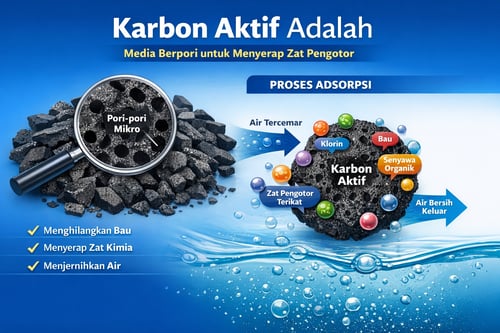
Activated carbon is a carbon material that has gone through an activation process so that it has a very large surface area and a large number of pores. With such a structure, activated carbon can capture and hold impurity molecules on its surface. This capture process is called adsorption, not absorption. Thus, activated carbon does not "suck" substances into its entire volume, but rather "attaches" them to the surface of its pores.
Because it has millions of micro pores, activated carbon works very effectively to absorb organic compounds, odors, tastes, colors, and certain contaminants in water. In addition, activated carbon is also often used for air treatment, purification of industrial raw materials, and decolorization processes in various applications.
In simple terms, if you ask "what is activated carbon a medium for?", then the answer is a medium for adsorption. This means that activated carbon helps purify liquids or gases by capturing impurities that stick to its porous surface.
Technical definition of activated carbon
Technically, activated carbon is an amorphous-structured carbon material with a high degree of porosity that is produced from carbon-rich raw materials, then physically or chemically activated. After the activation process, this material has a very large internal surface area. Therefore, one gram of activated carbon can have a surface area of hundreds to thousands of square meters, depending on the type and quality.
Apart from surface area, the quality of activated carbon is also affected by pore size distribution, substrate hardness, ash content, density, and iodine number. Therefore, the selection of activated carbon should not only look at price. Instead, you need to look at the technical specifications and application suitability so that the filtration results are truly optimal.
What is activated carbon made of?
Activated carbon comes from raw materials rich in the element carbon. For example, manufacturers can make activated carbon from coconut shells, coal, wood, sawdust, lignite, or other organic materials suitable for carbonization and activation processes.
However, not all raw materials produce the same characteristics. Activated carbon from coconut shells generally has an excellent micro pore structure and is often chosen for drinking water applications. Meanwhile, coal-based activated carbon is often used for industrial needs because it has a pore character that can adjust various types of contaminants.
Because of the differences in raw materials, you need to understand the purpose of its use. If you want to purify household water, then the choice of media can be different compared to the needs of factories, laboratories, or waste treatment.
How does activated carbon work?
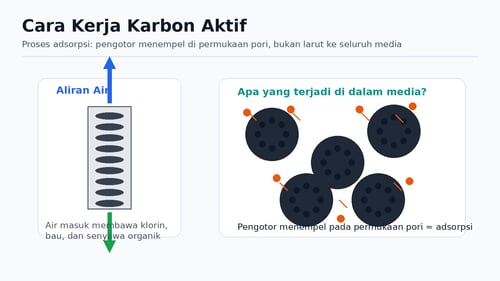
Activated carbon works through an adsorption process. As water flows through the activated carbon media, certain impurity molecules will be attracted and attached to the carbon pore surface. The larger the available pore area, the greater the adsorption capacity.
In addition, activated carbon also works very well for removing:
- unpleasant odors,
- strange taste in water,
- certain colors,
- chlorine,
- volatile organic compounds,
- certain chemical residues.
However, activated carbon does not work alone for all water problems. For example, activated carbon is not always effective for lowering total dissolved solids (TDS), dissolved salts, or all types of heavy metals without the support of other systems. Because of this, many filter systems combine activated carbon with silica sand, manganese greensand, resins, membranes, or other specialized media.
Difference between adsorption and absorption
Many people still confuse adsorption and absorption. In fact, the two are different.
Adsorption occurs when impurity molecules stick to the surface of the media. Activated carbon works with this mechanism. Meanwhile, absorption occurs when substances enter and are absorbed into all parts of the material. Therefore, when discussing activated carbon, the correct term is adsorption.
This distinction is important because it will help you understand why activated carbon has a certain capacity. When the entire active surface is saturated with impurities, the activated carbon's ability will decrease. At that point, the media needs to be replaced or regenerated, depending on the type and application.
Types of activated carbon
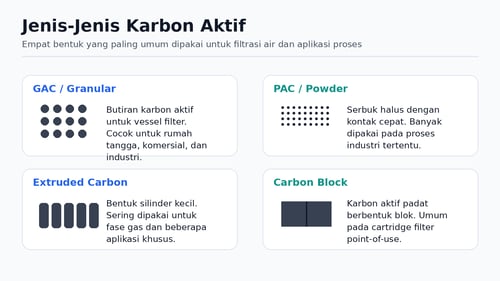
Activated carbon comes in several forms. Each form has different advantages and functions. Therefore, you need to choose the form that suits your system and intended use.
1. Granular Activated Carbon (GAC)
GAC or granular activated carbon has a granular shape. This type is very popular for household, commercial, and industrial water filters. In addition, GAC provides a relatively stable water flow making it suitable for vessel filters.
2. Powdered Activated Carbon (PAC)
PAC is in the form of fine powder. Usually, industries use PAC for certain processes that require fast contact. However, PAC is more difficult to use in ordinary cartridge filters because it is very fine.
3. Extruded Activated Carbon (EAC)
This type is in the form of small cylinders resulting from extrusion. Generally, EAC is often used for gas phase or air applications. In addition, some specialized systems also utilize it for liquids.
4. Carbon Block
Carbon blocks are formed from activated carbon that is compacted into blocks. Because this structure is tighter, carbon blocks can filter out fine particles while reducing odors and tastes. Therefore, many point-of-use filters use this form.
Examples of activated carbon usage
To make it easier to understand, here are some examples of how activated carbon is used in everyday life and industry.
Activated carbon for household water filters
At home, activated carbon is often used to reduce chlorine odor, bad taste, and certain colors in water. In addition, activated carbon also helps make water taste fresher when used for bathing, washing, or kitchen needs.
If you are looking for a reference to choose a suitable filtration system, you can read this guide: how to choose the right water filter for your household needs.
Activated carbon for the food and beverage industry
In the food and beverage industry, activated carbon helps with purification, deodorization, and color improvement. As such, many manufacturers rely on this medium to maintain the quality of the final product.
Activated carbon for pharmaceuticals
In the pharmaceutical sector, activated carbon is used to purify certain ingredients. In addition, the healthcare sector also recognizes activated carbon in specialized forms for the treatment of certain conditions, although these applications differ from water filter media.
Activated carbon for waste treatment
Activated carbon also helps to reduce certain organic compounds in wastewater. However, these systems usually work as part of a more complete treatment circuit. So, operators don't just rely on one media alone.
Activated carbon for air purification
In addition to liquids, activated carbon is also highly effective at absorbing odors and certain gaseous compounds. For this reason, many air purifiers, exhaust treatment, and ventilation systems use activated carbon.
Activated carbon for water: the main benefits
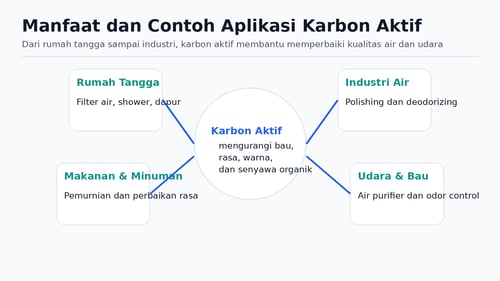
In water treatment, activated carbon offers many benefits. Here are the benefits that users are most often looking for.
1. Reduces odor
If the water has chlorine odor, organic matter odor, or other unpleasant smells, activated carbon can help reduce them significantly. Because of this, the water becomes more comfortable to use.
2. Improves taste
The taste of water often changes due to chlorine or certain organic compounds. With activated carbon, the taste of water usually becomes more neutral and fresh.
3. Decreases certain colors
Under certain conditions, activated carbon helps to reduce the color in water. However, its effectiveness still depends on the type of color cause.
4. Absorbs organic compounds
Activated carbon is well known for its ability to absorb various organic compounds. Hence, it is often incorporated into the design of polishing systems.
5. Supports better water quality
While activated carbon is not a single solution for all contaminants, it still contributes greatly to improving overall water quality.
Activated carbon vs regular charcoal
Many people think activated carbon is the same as regular charcoal. In fact, the two are very different.
Regular charcoal does come from the process of burning or carbonizing organic matter. However, it hasn't gone through an activation process that creates a lot of pores and a large surface area. Because of this, the absorbency of regular charcoal is much lower than activated carbon.
So, if you need a filtration media that really works for water or air, you can't just use ordinary charcoal. Instead, you need to use activated carbon, which is designed for adsorption.
The process of making activated carbon
In general, the manufacturing of activated carbon takes place through several key stages.
1. Raw material selection
Manufacturers choose carbon-rich materials, such as coconut shells or coal.
2. Carbonization
The raw material is heated under certain conditions so that non-carbon elements are reduced and a carbon structure is formed.
3. Activation
This stage is the main difference between ordinary charcoal and activated carbon. Manufacturers perform physical or chemical activation to open the pores and expand the surface area.
4. Size screening
After that, the media is processed to the required size, such as granular, powder, or block.
5. Quality control
Finally, manufacturers check important parameters such as particle size, moisture content, ash content, and adsorption capacity.
Important parameters in choosing activated carbon
When buying activated carbon, you shouldn't just look at its physical form. Instead, you need to check some of the following parameters.
Iodine number
The iodine number is often used as an indicator of the adsorption capacity of small molecules. The more this number matches the needs of the application, the more optimal results you will get.
Mesh size
Mesh size affects flow and contact area. Therefore, the flow rate system must match the media size.
Hardness
Media that is too brittle will break easily and produce fines. As a result, the differential pressure may increase and the system performance decreases.
Ash content
High ash content can affect the quality of the media. Therefore, many applications require good ash control.
Certifications and supporting documents
For sensitive applications, you also need to consider supporting documents and quality standards. For example, if you are looking for product references and related documents, you can view the Novasorb product page, Novasorb brand page, and Novasorb Activated Carbon Halal document.
When is activated carbon suitable for use?
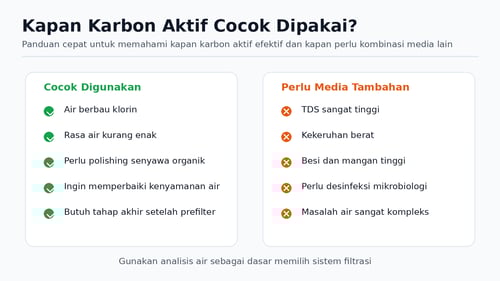
Activated carbon is suitable for use when you encounter the following problems:
- chlorine smelling water,
- the taste of water is not good,
- certain color in water,
- the presence of organic compounds that you want to reduce,
- the need for polishing in the water treatment system.
However, you need to check the water quality first. If the source of the problem comes from iron, manganese, high turbidity, high TDS, or microorganisms, then you may need a combination of other media. Therefore, water analysis is always a very important step before deciding on a system.
When is activated carbon less effective?
Although very useful, activated carbon is not a solution for everything. In many cases, activated carbon is less effective for:
- significantly lowering TDS,
- removing all types of heavy metals,
- killing microorganisms without the help of other technologies,
- dealing with heavy turbidity as a single stage,
- solve extreme water problems without pretreatment.
Therefore, a good system design should look at the character of the raw water. After that, only then do you determine the right combination of media and process sequence.
Is activated carbon safe?
In general, activated carbon is safe to use in a properly designed filtration system. However, you still need to pay attention to the quality of the media, the cleanliness of the system, and the replacement schedule. If the media is saturated but remains in use for too long, its performance will drop. In addition, a poorly maintained system can also reduce the quality of the filtrated water.
Therefore, you should use media from clear brands, appropriate specifications, and suppliers who understand water treatment applications.
How long is the lifespan of activated carbon?
The lifespan of activated carbon depends on several factors, namely:
- raw water quality,
- concentration of impurities,
- flow rate,
- vessel size,
- volume of use,
- type of activated carbon.
Therefore, there is no one number that always applies to all systems. In households, some users replace the media periodically based on performance, usage time, or water quality check results. Meanwhile, in industry, operators usually use operational data and effluent quality monitoring to determine replacement times.
How to tell if activated carbon is saturated
You can recognize activated carbon that is getting saturated through the following signs:
- The odor in the water starts to reappear.
- The taste of the water changes again.
- The quality of filtration results decreases.
- The media usage time has passed the normal estimation.
- Water test results show that target parameters are starting to rise.
Therefore, regular monitoring is essential. Don't wait for the system to completely fail before replacing the media.
Tips for choosing the right activated carbon
For optimal filtration results, follow these tips.
Recognize the purpose of use
First, determine your purpose. Do you want to reduce odor, improve taste, reduce color, or polish process water? This goal will determine the type of media that is suitable.
Check raw water quality
Second, analyze the raw water before purchasing the media. With clear data, you can avoid making the wrong choice.
Choose the appropriate media form
Third, adapt the media shape to your system. For filter vessels, GAC is often a practical choice. For certain cartridges, carbon blocks can be more suitable.
Pay attention to the brand and specifications
Fourth, choose a product with clear technical information. That way, you can objectively assess the quality of the media.
Consult the system design
Fifth, don't just focus on the media. You also need to look at the tube size, contact time, flow rate, backwash if any, and filtration sequence. Therefore, the system design should be thorough.
Example of home application of activated carbon
For example, a house uses water with a strong chlorine odor. Under these conditions, activated carbon can be a very effective solution. After the water passes through the activated carbon media, the odor usually decreases, the taste of the water improves, and the comfort of use increases.
However, if the home also has yellow water problems due to iron or manganese, then activated carbon alone is not enough. Instead, the system may need to add special oxidation or filtration media before the activated carbon stage. Thus, the final result becomes much better.
Examples of activated carbon applications in business and industry
In laundry businesses, restaurants, hotels, food factories, or other commercial facilities, water quality affects the quality of services and products. Therefore, many businesses use activated carbon as part of their treatment system.
In restaurants, cleaner and odorless water supports the quality of drinks and ice. In hotels, more comfortable water enhances the guest experience. Meanwhile, in the process industry, activated carbon helps maintain consistent water quality for daily operations.
Why is activated carbon important to a water treatment strategy?
Activated carbon is important because it provides an efficient solution to many common water quality problems. In addition, activated carbon is also relatively flexible, easy to integrate, and available in a variety of specifications. For that reason, this media is becoming a key component in many modern water treatment systems.
Furthermore, activated carbon often serves as the "finisher" in a treatment circuit. That is, after other media reduce particles, iron, manganese, or turbidity, activated carbon improves water quality by reducing odor, taste, and certain organic compounds. So, activated carbon is not only important, but also very strategic.
FAQ about activated carbon
Is activated carbon the same as charcoal?
No, it's not. Activated carbon has gone through an activation process so it has more pores and much higher adsorption power.
What is activated carbon for?
Activated carbon is used to absorb odor, taste, color, chlorine, and certain organic compounds in water and air.
Can activated carbon purify water?
Yes, especially for odor, taste, and some organic substances. However, the best results usually occur when activated carbon works with other media according to the needs of the raw water.
Can activated carbon remove all contaminants?
No, it doesn't. Activated carbon is very effective for some parameters, but not for all water problems.
When does activated carbon need to be replaced?
Activated carbon needs to be replaced when its adsorption capacity decreases, system performance drops, or monitoring results show water quality is no longer on target.
Conclusion
Activated carbon is a highly porous adsorption medium that is highly effective for improving water and air quality. Due to its large surface area, activated carbon is able to capture odor, taste, color, chlorine, and a variety of specific organic compounds. In addition, activated carbon also comes in many forms, such as granular, powder, and carbon block, so users can customize it according to application needs.
However, activated carbon is not a single solution for all types of contaminants. Therefore, you need to thoroughly understand the raw water conditions, treatment objectives, and system design. If you choose the right media, install it in the right system, and maintain it regularly, then activated carbon will give you maximum results.
For more references on media and related solutions, you can check out Novasorb media products, Novasorb brand, Novasorb Activated Carbon Halal document, as well as the article on how to choose the right water filter for your household needs.
-1.png?width=352&name=Karbon%20aktif%20adalah%20material%20yang%20sangat%20penting%20dalam%20berbagai%20industri%2c%20terutama%20untuk%20pemurnian%20dan%20filtrasi%20air%2c%20udara%2c%20dan%20bahan%20kimia.%20Dua%20jenis%20karbon%20aktif%20yang%20paling%20umum%20digunakan%20adala%20(1)-1.png)