
Accessories & Ancillaries
Chemical Injection Pumps for WTP
Select a chemical injection pump by dosing rate, pressure, concentration, wetted materials, controls, suction, accessories, calibration, and injection point.
Chemical Injection Pumps for WTP and Water Processes
A chemical injection pump, or dosing pump, feeds a chemical solution into a water stream at a controlled rate and pressure. PT Watermart Perkasa supplies HYDROPRO, LMI/Milton Roy, and OBL. Select the model from the L/h you need, the injection pressure, the chemical and its concentration, the wetted materials, the controls, the suction and discharge conditions, and the installation accessories.
Updated 16 November 2026: pump-name and drive-type section added. The chlorine-sizing guidance is unchanged.
Before you choose a model, use the dosing-pump types and selection guide to compare drive types, wetted materials, suction, antisiphon control, relief, pulsation, and fail states.
What is a dosing pump, and which drive type should you choose?
A dosing pump, a chemical injection pump, and a metering pump are the same thing: a pump that feeds a chemical solution into a water stream at a measured rate. Products on the market differ in their drive: electromagnetic (solenoid), motor-driven diaphragm, hydraulic diaphragm, or plunger. Capacity, maximum pressure, wetted materials, and control options vary by model and configuration. Check all four against each model’s catalogue specifications. The process data still has to be matched before a model is selected.
| Drive | Product family | Capacity | Maximum pressure | Wetted materials | Control |
|---|---|---|---|---|---|
| Electromagnetic (solenoid) with PTFE diaphragm | HYDROPRO D Series | 2 – 9 L/h | 7 – 16 bar | PTFE, PVC | Digital, manual |
| Motor-driven (mechanical) diaphragm and electronic metering | LMI GM, P, G Series | 2 – 1800 L/h | 3.4 – 17.3 bar | PVC, PVDF, 316SS, PTFE, Viton, Ceramic | Manual, 4–20 mA, ON/OFF |
| Mechanical diaphragm, hydraulic diaphragm, and plunger | OBL MB, M, R, XRN, MC, MD | 0.6 – 1500 L/h | MB/M up to 12 bar; XRN up to 40 bar; R up to 100 bar; MC/MD not published | PP, AISI 316L, PVDF, PTFE, Hastelloy | Manual, electronic, pneumatic |
To compare LMI models one by one, including head and control-signal options, see the LMI Milton Roy dosing pump range. Where the duty is not measured chemical injection, see the process and booster pumps for water treatment.
How do you size a chlorine dosing pump?
Calculate the theoretical flow from the water flow and the chlorine dose, divided by the available chlorine in the working solution: pump L/h = water flow (m³/h) × dose (mg/L) ÷ solution available chlorine (g/L). Use the strength of the working solution you actually prepared, not the calcium-hypochlorite percentage before dilution. The applied dose must come from chlorine demand, target residual, contact time and test results. This page does not set a universal dose.
| Sizing input | Data required |
|---|---|
| Water flow | Minimum, normal, and maximum m³/h |
| Applied dose | mg/L established from testing and process requirements |
| Solution strength | Actual available chlorine in g/L after dilution and storage changes |
| Injection condition | Line pressure, elevation, tubing length, back pressure, and injection-quill location |
| Outcome control | Sampling point, effective contact time, residual target, analyzer or test method, and interlock |
Worked initial sizing: 20 m³/h water flow, a 2 mg/L applied dose, and a working solution containing 20 g/L available chlorine gives 20 × 2 ÷ 20 = 2 L/h. This is only the theoretical duty. Select a pump that covers minimum-normal-maximum flow at actual pressure. Calibrate it with a calibration column. Then correct the set point from residual after contact time. Use the chlorine dose and pump-rate guide for the full process method.
What data is required when buying a dosing pump?
A useful quotation comparison uses the same duty point and accessory scope. Pumps with similar nominal capacity may need different heads, diaphragms, motors, or controls when chemical concentration, temperature, and injection pressure change.
| Quotation factor | Information to send | Selection impact |
|---|---|---|
| Dosing rate and turndown | Minimum, normal, and maximum L/h | Sets pump size and adjustment range |
| Injection-point pressure | Normal and maximum line pressure | Sets pressure rating and operating margin |
| Chemical and concentration | Chemical name, concentration, temperature, and SDS when available | Sets head, valve, seal, and diaphragm materials |
| Control system | Manual, pulse, 4–20 mA, PLC, or SCADA | Sets controller type and communication options |
| Accessory scope | Tank, agitator, calibration column, relief valve, back-pressure valve, and injection quill | Separates a pump-only price from an installable dosing package |
Send these details with the power supply, operating pattern, installation location, and existing nameplate photos when replacing a unit. Watermart can then confirm the model, availability, and quotation scope through the Watermart contact page.
How should HYDROPRO, LMI, and OBL be compared?
Compare HYDROPRO, LMI/Milton Roy, and OBL by duty point, pressure, chemical, control method, and operating pattern. The brand name alone is not enough to select a dosing pump. PT Watermart Perkasa supplies all three pump families through water.co.id in Indonesia. Therefore a quotation can separate the pump, accessories, panel, spare parts, and commissioning scope.
| Option | Consider it when | Deciding data |
|---|---|---|
| HYDROPRO electromagnetic | Small to medium duties for chlorination, pH adjustment, antiscalant, or WTP chemical feed | L/h, pressure, control mode, head material, and service interval |
| LMI/Milton Roy | Projects need electronic or mechanical ranges, signal-control options, and broader capacities | Pump series, pressure rating, chemical, power supply, and panel integration |
| OBL mechanical/hydraulic/plunger | Heavier duty, larger capacity, higher pressure, or specific process liquids are involved | Viscosity, wetted materials, duty cycle, pulsation, and relief path |
| Complete dosing package | The buyer needs an installable system, not only a pump | Tank, agitator, calibration column, back-pressure valve, relief valve, injection quill, and panel |
For a neutral comparison of drive types (solenoid, motor diaphragm, stepper), turndown, materials and control inputs, including SEKO, Grundfos and ProMinent, which we do not supply, read dosing pumps compared: HYDROPRO, LMI, OBL vs SEKO, Grundfos, ProMinent.
Which installation conditions must be checked before selecting a dosing pump?
Check the suction and discharge sides before fixing the dosing-pump model. A duty point alone does not describe tank position, pipe length, changing liquid level, gas release, back pressure, or siphoning risk. These installation inputs shape the pump configuration and the accessories needed for installation, calibration, isolation, and maintenance at the project site.
| Installation condition | Information to provide | Decision to make |
|---|---|---|
| Tank and suction | Minimum/maximum liquid level relative to the pump, distance, pipe diameter, and fitting count | Flooded suction or suction lift, plus strainer and isolation-valve placement |
| Chemical behaviour | Viscosity, temperature, crystallization risk, solids, or gas release | Materials, priming method, agitation, and any special head or valve |
| Discharge and injection point | Minimum/maximum line pressure, elevation, distance, and injection-quill location | Pressure rating, back-pressure valve, relief path, and siphon prevention |
| Operation and maintenance | Indoor/outdoor location, ventilation, work area, drain, power, controls, and service access | Enclosure, cable entry, calibration column, tray, and component-removal space |
Include photographs of the complete route from tank to injection point, not just the pump nameplate. Then the quotation can separate the replacement unit from the tubing, valve, panel or accessory changes the installation needs.
How is dosing-pump capacity verified after installation?
A dosing pump should be calibrated on site at the actual suction condition and discharge pressure. Model selection alone does not prove the delivered injection rate. Commissioning must follow the model manual, the chemical SDS and the site safety procedure. It must be done by competent personnel.
- Check flow direction, wetted materials, valves, relief path, back-pressure control, tubing, power and control signal against the approved documents.
- Prime the pump and do the leak checks in the manual before feeding chemical to the injection point.
- Measure the actual volume with a calibration column or an approved measurement method over a recorded interval at operating pressure.
- Record the stroke or frequency setting, control mode, pressure, tank level, measured output and any set-point correction.
- Correlate the injection rate with the relevant process parameter. Then define the inspection, consumables and spare-parts requirements.
For chlorination, pH control or another outcome-based duty, verification should use suitable sampling or instrumentation after the process response time. Keep the commissioning baseline. Then you can tell output loss, valve fouling, leaks or pressure changes apart during troubleshooting.
Quick dosing pump selection guide
| Buyer requirement | Pump type commonly considered | Related component |
|---|---|---|
| Chlorine, pH adjustment, or disinfection dosing at a WTP | HYDROPRO electromagnetic or LMI electronic metering pump | Disinfection systems and cartridge housing |
| Antiscalant, sodium metabisulfite, or chemical feed before RO | LMI/Milton Roy or OBL selected for flow, pressure, and chemical compatibility | Reverse Osmosis, RO membranes, and Codeline vessels |
| Coagulant, flocculant, or WWTP dosing | OBL mechanical/hydraulic diaphragm or plunger pump for the required duty | OBL dosing pumps and chemical-program support from Beta Pramesti |
| Existing-unit replacement | Match brand, flow, pressure, head material, connections, power, and control signal | Send the nameplate and installation photos through the Watermart contact page |
Dosing pumps and accessories for water treatment

PT Watermart Perkasa supplies dosing pumps and accessories for clean-water, wastewater, food and beverage, pharmaceutical and industrial-process applications. Selection support covers the duty point, chemical compatibility, control signal and the accessories needed around the pump.
For chlorination duties, use this calcium hypochlorite dose, demand, residual, and pump-rate guide before you specify L/h capacity. The final setting still needs calibration at the actual injection pressure and verification from residual after the effective contact time.
Dosing pump FAQ
What is a dosing pump?
A dosing pump is a pump that feeds a chemical solution into a water stream at a controlled rate and pressure. In water treatment the term means the same as chemical injection pump or metering pump. PT Watermart Perkasa supplies three groups: HYDROPRO electromagnetic, LMI/Milton Roy mechanical and electronic metering, and OBL mechanical diaphragm, hydraulic diaphragm and plunger. We select the model from the L/h rate, injection pressure, chemical and concentration, wetted materials and control method.
How do you determine chlorine dosing pump capacity?
Calculate the theoretical flow from the water flow multiplied by the chlorine dose, divided by the available chlorine in the working chemical solution. Then match the minimum, normal and maximum flow, the injection pressure, the materials, the turndown, the controls and the accessories. The actual capacity must be calibrated on site and checked from the residual after the contact time.
Who supplies dosing pumps for water treatment in Indonesia?
PT Watermart Perkasa supplies HYDROPRO, LMI/Milton Roy and OBL dosing pumps through water.co.id. The pumps are used for WTP, WWTP, RO, chlorination, pH control and industrial chemical-feed duties in Indonesia.
What determines the price of a dosing pump?
The price of a dosing pump is set by the duty point and the scope requested, not by L/h capacity alone. The main factors are the minimum, normal and maximum dosing rate and its adjustment range, the pressure at the injection point, the chemical type and concentration that set head, valve, seal and diaphragm materials, the control system (manual, pulse, 4–20 mA, PLC or SCADA), and the accessory scope such as tank, agitator, calibration column, relief valve, back-pressure valve and injection quill. Two quotations can only be compared at the same duty point and accessory scope. Send these details through the Watermart contact page so the team can confirm the model and quotation scope.
Dosing pump ranges available
A dosing pump meters chemicals into water or process liquid at a defined rate and pressure. PT Watermart Perkasa supplies the following pump ranges:
- HYDROPRO - Electromagnetic Dosing Pump
- LMI (Milton Roy) - Mechanical & Electronic Metering Pump
- OBL - Mechanical Diaphragm, Hydraulic Diaphragm, and Plunger Metering Pump
Compare each range by duty point, wetted materials, control method and maintenance requirements.
1. HYDROPRO D Series Electromagnetic Dosing Pump
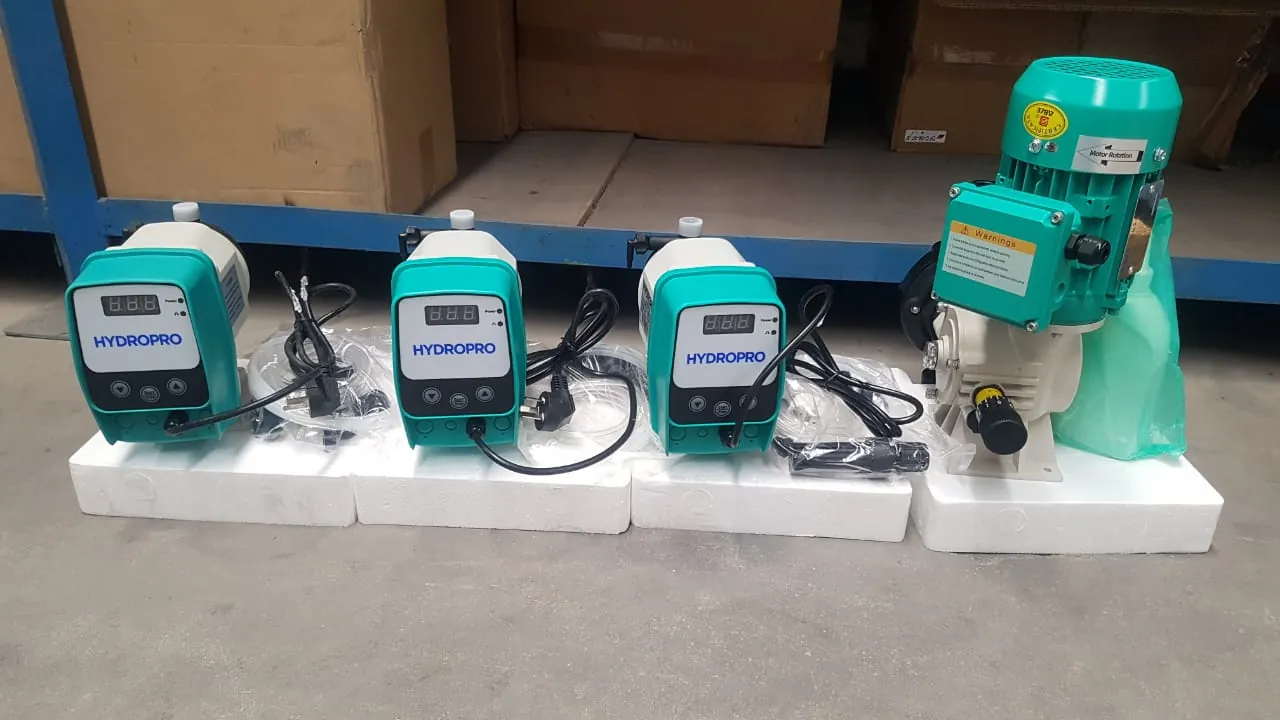
HYDROPRO D Series uses an electromagnetic drive and PTFE diaphragm for water and wastewater applications. Match capacity, pressure, head material, control and chemical compatibility before using it for disinfectants, coagulants or pH adjustment.
- High precision and energy efficiency
- Corrosion-resistant wetted parts material (PTFE diaphragm)
- Integrated digital control
- Up to 5 years diaphragm warranty
- Compatible with many chemicals
For technical details, please download the official brochure:
Download Brochure Dosing Pump Hydropro.pdf
See the HYDROPRO dosing-pump range.
2. LMI (Milton Roy) - Mechanical & Electronic Metering Pump
LMI is part of Milton Roy. PT Watermart Perkasa supplies mechanical-diaphragm and electronic-metering series with manual, 4–20 mA, ON/OFF or inverter control options depending on the model.
- Dosing capacity ranging from 2 L/h to 1800 L/h
- PTFE diaphragm technology, wetted parts material: PVC, PVDF, 316SS, Viton, Ceramic
- Manual and automatic control options (PLC, SCADA, 4-20mA)
- Corrosion resistant design, suitable for aggressive chemicals
- Easy integration with modern water treatment systems
Some popular types available:
- LMI GM Series (GM0025TR1MN, GM0050PR1MNN, GM0090SP1MNN, GM0240PP1MNN, GM0240TP1MNN, GM0330PP1MNN, GM0500SP1MNN)
- LMI P Series (P033-398TI, P043-358TI, P053-398TI, P063-368TI, P023-358TI)
- Milton Roy G Series
- LMI Electronic Metering Pump Series P
See the LMI product details on this page: LMI Dosing Pump
Download the official datasheet and brochure for technical reference:
- Download LMI GM0025TR1MN.pdf
- Download LMI GM0050PR1MNN.pdf
- Download LMI GM0090SP1MNN.pdf
- Download LMI GM0240PP1MNN.pdf
- Download LMI GM0240TP1MNN.pdf
- Download LMI GM0330PP1MNN.pdf
- Download LMI GM0500SP1MNN.pdf
- Download LMI P033-398TI.pdf
- Download LMI P043-358TI.pdf
- Download LMI P053-398TI.pdf
- Download LMI P063-368TI.pdf
- Download LMI Unit P023-358TI.pdf
- Download Milton Roy G Series.pdf
- Download LMI MILTON ROY G SERIES.pdf
3. OBL - Mechanical, Hydraulic and Plunger Metering Pump
OBL makes mechanical-diaphragm, hydraulic-diaphragm and plunger metering pumps for different capacity and pressure duties. PT Watermart Perkasa supplies the OBL series for water treatment, chemical processes, food and beverage, and mining applications. We select the series from the process data.
- MB Series: Mechanical diaphragm dosing pump, flow rate 11-155 L/h, max pressure up to 12 bar
- M Series: Mechanical diaphragm, flow 7-1,500 L/h, pressure up to 12 bar, food grade option
- R Series: Plunger pump, pressure up to 100 bar, suitable for high viscosity liquids
- XRN Series: Hydraulic diaphragm, flow 0.6-105 L/h, pressure up to 40 bar
- MC/MD Series: Large capacity, PP material for chemical resistance
OBL advantages:
- Wetted parts material: PP, AISI 316L, Hastelloy, PVDF, PTFE
- Compact design, easy to install and maintain
- Manual and electronic actuator options
- Multiplex configuration for multi-point dosing
- EC 1935/2004 compliance for food & beverage applications
See OBL product details on the following page: OBL dosing-pump selection guide
Download the official OBL datasheet for technical reference:
- Download MB series.pdf
- Download OBL Dosing Pump MB101.pdf
- Download OBL Dosing Pump MB31PP.pdf
- Download OBL Dosing Pump MB75PP.pdf
- Download OBL Dosing Pump MC261PP.pdf
- Download OBL Dosing Pump MC321PP.pdf
- Download OBL Dosing Pump MD521PP.pdf
- Download OBL M Series.pdf
- Download OBL R Series.pdf
- Download OBL XRN Series.pdf
PT Watermart Perkasa support scope
- Model, part-number and availability checks at quotation
- Capacity, pressure, material, power-supply and control-signal matching
- Accessory selection for calibration columns, relief valves and back-pressure valves
- Coordination of dosing panels, PLC or SCADA requirements when they are in the project scope
Common Applications of Dosing Pump
- Water & wastewater treatment plant (WTP, WWTP)
- Chemical, petrochemical, food-beverage, pharmaceutical industries
- Cooling tower, boiler and industrial utility systems
- Laboratory, pilot plant and research applications
- Paper mills, textiles and wastewater treatment
Full Brochure and Datasheet Download
For more detailed technical information, please download the following official documents:
- Download Brochure Dosing Pump Hydropro.pdf
- Download LMI GM0025TR1MN.pdf
- Download LMI GM0050PR1MNN.pdf
- Download LMI GM0090SP1MNN.pdf
- Download LMI GM0240PP1MNN.pdf
- Download LMI GM0240TP1MNN.pdf
- Download LMI GM0330PP1MNN.pdf
- Download LMI GM0500SP1MNN.pdf
- Download LMI P033-398TI.pdf
- Download LMI P043-358TI.pdf
- Download LMI P053-398TI.pdf
- Download LMI P063-368TI.pdf
- Download LMI Unit P023-358TI.pdf
- Download Milton Roy G Series.pdf
- Download LMI MILTON ROY SERIES P.pdf
- Download MB series.pdf
- Download OBL Dosing Pump MB101.pdf
- Download OBL Dosing Pump MB31PP.pdf
- Download OBL Dosing Pump MB75PP.pdf
- Download OBL Dosing Pump MC261PP.pdf
- Download OBL Dosing Pump MC321PP.pdf
- Download OBL Dosing Pump MD521PP.pdf
- Download OBL M Series.pdf
- Download OBL R Series.pdf
- Download OBL XRN Series.pdf
Contact PT Watermart Perkasa
For dosing-pump selection or a quotation, send the duty point, chemical, controls, power supply and accessory scope to PT Watermart Perkasa by WhatsApp or email.