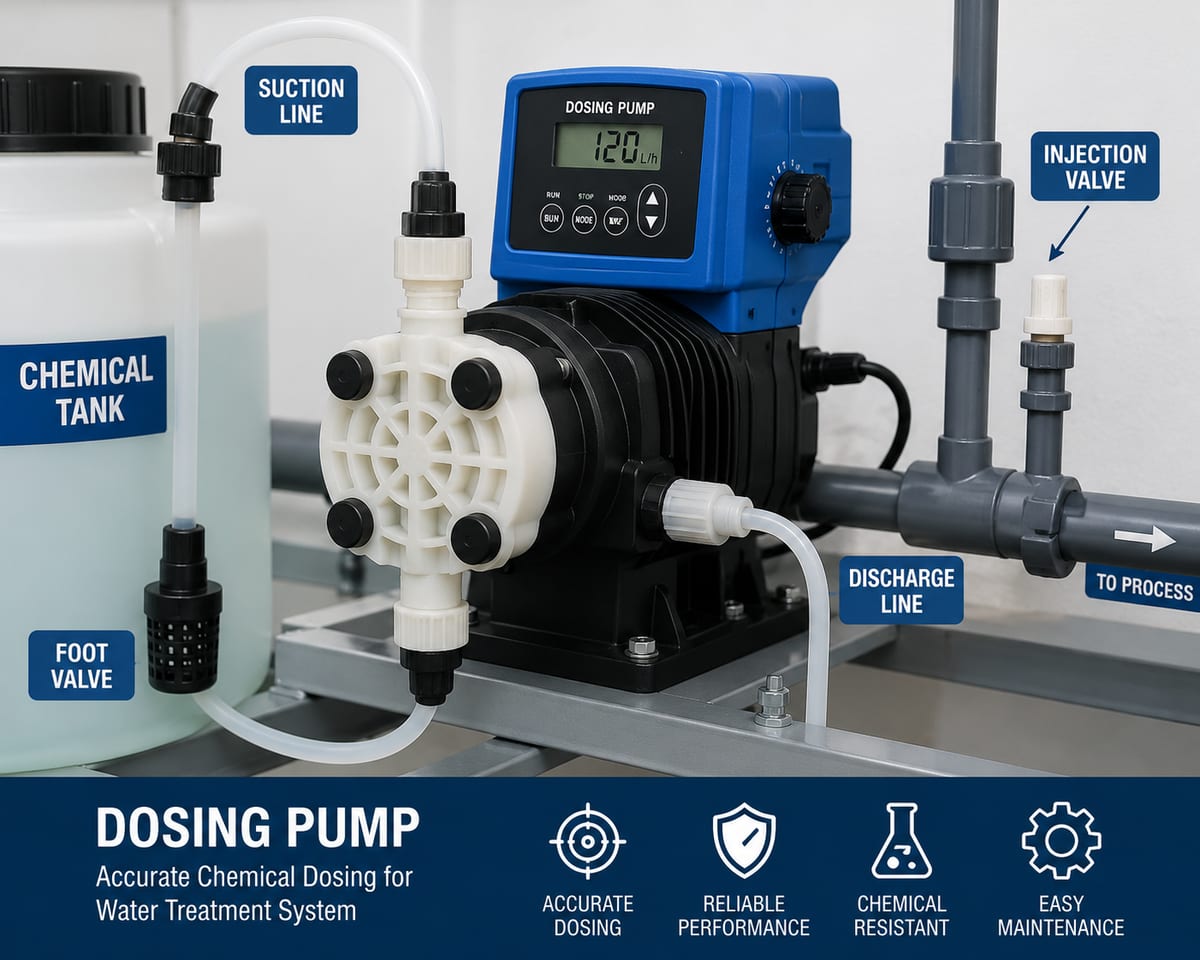
Choose a dosing pump by drive type first and brand second: solenoid pumps for small, frequently changing flows, motor-driven mechanical-diaphragm pumps for larger flows and continuous duty, and digital stepper pumps for very wide turndown. PT Watermart Perkasa supplies HYDROPRO, LMI/Milton Roy and OBL; this article also compares SEKO, Grundfos and ProMinent neutrally from their public documents.
Updated 12 November 2026.
What is the difference between solenoid and motor-diaphragm dosing pumps?
A solenoid pump drives the diaphragm with electromagnetic pulses, while a motor-driven pump turns an eccentric shaft that pushes a diaphragm or plunger on every revolution. This decides the flow and pressure range, how capacity is adjusted, and maintenance.
- Solenoid (electromagnetic): each electrical pulse makes one stroke. Capacity is set by stroke frequency and, on many models, stroke length. Suits small flows such as chlorination, pH correction or RO antiscalant on small to medium systems.
- Motor with mechanical diaphragm: an electric motor and gearbox drive the diaphragm. Flow and pressure can be higher, suiting continuous duty in water and wastewater plants and process lines. Capacity is set by stroke length and, on some models, an inverter or electronic actuator.
- Digital stepper motor: a stepper motor varies stroke speed continuously, giving smoother flow and a wide adjustment range.
- Hydraulic diaphragm and plunger: for high pressure or difficult fluids in chemical and heavy industry.
Dosing pump types compared
| Type | How flow is adjusted | Strengths | Limits | Example lines (sources below) |
|---|---|---|---|---|
| Solenoid | Stroke frequency, stroke length | Compact, simple, suited to small flows | Lower maximum flow and pressure; pulsating flow | HYDROPRO D Series, LMI P Series, SEKO Tekna EVO, ProMinent gamma/ X |
| Motor, mechanical diaphragm | Stroke length; inverter or actuator on some models | Larger flows, continuous and heavy duty | Larger and heavier; needs a discharge relief valve | LMI/Milton Roy G and GM, OBL MB and M, ProMinent Sigma and alpha |
| Digital stepper motor | Continuous motor speed | Very wide turndown, smoother flow | More complex electronics; limited flow range per model | Grundfos SMART Digital DDA, DDC, DDE |
| Hydraulic diaphragm / plunger | Stroke length; actuator | High pressure, viscous or process fluids | Larger size and maintenance | OBL XRN (hydraulic diaphragm), OBL R (plunger) |
How do the brands compare?
Each brand below offers more than one drive type, so compare model with model, not brand with brand. Figures come from the manufacturer documents listed under Sources and may change; confirm the data sheet of the model quoted.
| Brand | Lines and drive type | Published range | Available from Watermart |
|---|---|---|---|
| HYDROPRO | D Series solenoid, PTFE diaphragm, PVC wetted parts | 2–9 L/h, 7–16 bar | Yes, HYDROPRO |
| LMI / Milton Roy | P Series electronic (solenoid); G and GM motor-driven mechanical diaphragm | Whole range 2–1,800 L/h; P Series up to 17.3 bar on certain models | Yes, LMI |
| OBL | MB and M motor-driven mechanical diaphragm; XRN hydraulic diaphragm; R plunger | MB 11–155 L/h up to 12 bar; XRN up to 40 bar; R up to 100 bar | Yes, OBL |
| SEKO | Tekna EVO solenoid; SEKO also makes motor-driven mechanical-diaphragm pumps | Tekna EVO 0.4–54 L/h, up to 20 bar | Not supplied by Watermart |
| Grundfos | SMART Digital DDA, DDC, DDE with stepper motor | 0.0025–30 L/h; turndown up to 1:3000 (DDA, DDC) | Not supplied by Watermart |
| ProMinent | gamma/ X and gamma/ XL solenoid; alpha and Sigma motor-driven | gamma/ X 1 mL/h–45 L/h (25–2 bar); Sigma/ 3 up to 1,030 L/h | Not supplied by Watermart |
Brands we do not supply are listed so that the comparison of pump types is complete. For SEKO, Grundfos or ProMinent units, contact that brand’s distributor.
What is turndown and why does it matter?
Turndown is the ratio of the maximum to the minimum flow a single pump can still deliver accurately. Wide turndown matters when the treated-water flow varies a lot or one pump has to serve several solution strengths.
- On solenoid pumps, flow is set by stroke frequency and length. The LMI Series P data sheet, for example, lists an adjustable stroke rate and a recommended minimum stroke length of 20–30%.
- On motor-driven mechanical-diaphragm pumps, stroke length is the main adjustment. The OBL MB data sheet states that flow is linear with stroke percentage and practically unaffected by changes in working pressure.
- Digital stepper pumps vary motor speed continuously; Grundfos lists turndown of up to 1:3000 for the DDA.
Do not choose a pump whose normal duty sits at the bottom of its adjustment range. Pick a model whose minimum, normal and maximum flows all fall within its accurate range at the actual injection pressure.
Which materials touch the chemical?
Pump head, valves, balls, seals and diaphragm must suit the chemical, its concentration and its temperature. Common options published by the manufacturers include PVC, PP, PVDF and 316 stainless steel heads; PTFE diaphragms; and ceramic, PTFE, FKM or EPDM balls and seals. SEKO Tekna EVO uses a PVDF head and ceramic balls as standard; Grundfos SMART Digital offers PP, PVC, PVDF or stainless-steel heads; LMI lists PVC, PVDF, 316SS and ceramic; OBL lists PP, AISI 316L, Hastelloy, PVDF and PTFE.
Check the SDS and the manufacturer’s compatibility table for every wetted part. See also what is a dosing pump and tips for choosing a dosing pump.
Which control inputs should you plan for?
| Control need | Common input | Note |
|---|---|---|
| Constant flow | Manual (stroke setting or L/h) | Simplest; suits a stable water flow |
| Proportional to water flow | Pulse from a water meter | Many solenoid pumps accept a pulse input |
| Following a PLC or analyser | Analogue 4–20 mA | Make sure the pump has an analogue-input variant; LMI calls this the instrument-responsive variant |
| Interlocks and alarms | Tank level switch, stop or start signal | Stop the pump when the tank is empty or the main pump stops |
| Plant network | Fieldbus such as Modbus | Grundfos lists integrated Modbus RTU and TCP on the DDA; check availability per model for other brands |
What to send for a quotation
- Chemical name, working-solution concentration, temperature and SDS.
- Minimum, normal and maximum dosing flow in L/h.
- Pressure at the injection point and maximum line pressure.
- Control mode: manual, pulse, 4–20 mA or a PLC/SCADA signal.
- Supply voltage, operating hours, standby pump requirement and a nameplate photo if replacing an existing unit.
- Accessories: calibration column, relief valve, back-pressure valve, injection valve and tank.
Send this data through the Watermart contact form or compare options in the dosing pump category. The chemicals being dosed, such as coagulants or antiscalants, are supplied by our sister company through beta.co.id.
Dosing pump FAQ
Which is better, a solenoid or a motor-driven dosing pump?
Neither is always better. Solenoid pumps are compact and suit small flows; motor-driven mechanical-diaphragm pumps suit larger flows and continuous duty. Choose from flow, pressure, chemical and control method.
What is turndown on a dosing pump?
Turndown is the ratio of the maximum to the minimum accurate flow. Digital stepper pumps such as the Grundfos DDA list up to 1:3000; solenoid and motor pumps set flow by stroke frequency and length.
Which dosing pump brands does Watermart supply?
PT Watermart Perkasa supplies HYDROPRO, LMI/Milton Roy and OBL. SEKO, Grundfos and ProMinent are discussed in this article for comparison and are not supplied by Watermart.
Can a dosing pump accept a 4–20 mA signal from a PLC?
Yes, if the chosen model has an analogue input. Many lines offer manual variants and variants with pulse or 4–20 mA inputs, so state the signal you need when requesting a quotation.
What determines the price of a dosing pump?
Flow and pressure, head material, drive type, control variant and accessories. Quotations can only be compared when the duty point and accessory scope are the same.
Sources
- HYDROPRO, LMI/Milton Roy and OBL documents on the Watermart dosing pump page, including the LMI Series P data sheet and the OBL MB Series data sheet.
- SEKO, Tekna EVO solenoid dosing pumps brochure; SEKO range summary at Lenntech.
- Grundfos, SMART Digital S DDA, DDC, DDE and DDA brochure.
- ProMinent, solenoid-driven metering pumps and motor-driven metering pumps.