.png?width=50&height=50&name=Logo_Watermart_Perkasa-removebg-preview%20(1).png)
Boreholes become the primary solution when surface water supply is unstable, PDAM water quality is inconsistent, or water demand increases significantly. Therefore, households, commercial buildings, industries, and public facilities increasingly rely on boreholes as an independent water source. However, many borehole projects fail to deliver optimal results due to improper system planning. Therefore, this article thoroughly discusses boreholes, from the basic concepts, construction stages, to professional product recommendations that support a stable, efficient, and long-lasting clean water system.
It also helps you understand the mandatory components of a modern borehole system. This way, you can make the right technical decisions while improving the system's performance on an ongoing basis.
What is a drilled well and why is it widely used?

A borehole well extracts groundwater through vertical drilling until it reaches the aquifer layer. Unlike dug wells, drilled wells penetrate through hard soil layers, resulting in a more stable flow rate. In addition, boreholes also provide more consistent water quality if the system is designed correctly.
Furthermore, boreholes support year-round water needs. Therefore, many property owners choose boreholes as a long-term investment. However, for the system to work optimally, you need to understand each component that makes up the borehole system.
The Correct Stages of Borehole Construction
1. Site Survey and Needs Analysis
First, you need to determine your daily water needs. Next, you must estimate the desired discharge, pressure, and water quality. That way, the system design becomes more accurate.
2. Drilling Process
Once the survey is complete, the technical team drills down to the aquifer. At this stage, the depth of the well greatly affects the pump and distribution system specifications.
3. Water Pump Installation
Once the drilling is complete, the system requires a suitable pump. Therefore, pump selection is a key factor in the success of the borehole.
👉 Pump product recommendations are available here:
Best pump recommendations
Submersible pumps are often used for deep wells, while jet pumps are suitable for specific depths. In addition, quality pumps keep the discharge stable and reduce energy consumption.
The Important Role of Pressure Vessel in a Wellbore System
Once the pump is running, the system needs a pressure vessel to keep the pressure stable. Without a pressure vessel, the pump will often turn on and off. As a result, the life of the pump decreases drastically.
Pressure vessels store pressurized water. Additionally, it keeps the water flow constant throughout the point of use.
👉 Check out our selection of professional pressure vessels here:
Best Pressure Vessel Recommendations
With the right pressure vessel, wellbore systems work more efficiently, are quieter, and last longer.
FRP Tank: A Mandatory Reservoir for Modern Wellbore Systems
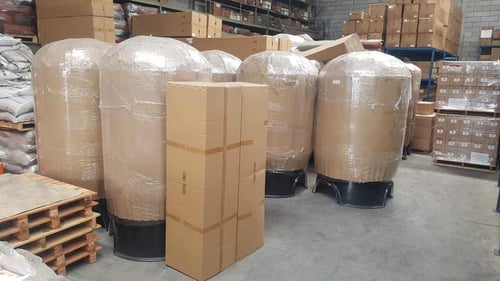
In addition to the pressure vessel, the system also requires a water storage tank. FRP (Fiberglass Reinforced Plastic) tanks offer significant advantages over conventional tanks.
First, FRP tanks do not rust. Second, FRP material is resistant to changes in water quality. Third, FRP tanks have a long service life.
👉 FRP tank recommendations are available here:
FRP Tank Recommendations
More importantly, FRP tanks help keep the system running even if the pump temporarily stops. Thus, the water supply remains secure.
Why is Filtration System So Important in Bore Wells?
Borehole water often contains iron, manganese, odors, or fine particles. Therefore, filtration systems play a crucial role. Without filtration, water quality deteriorates and equipment breaks down quickly.
Anthracite Media Filter
Anthracite filters out fine particles and improves water clarity. In addition, this media works effectively as the initial stage of filtration.
👉 You can see anthracite media filter products here:
Anthracite media filter recommendations
With anthracite, the filtration system works more efficiently and downstream equipment is protected.
The Role of Dosing Pump in Borehole Water Treatment
.jpg?width=500&height=557&name=Dosing%20Pump%20hydropro%20(2).jpg)
When water quality requires chemical adjustments, the system needs a dosing pump. Dosing pumps inject chemicals in a controlled manner. Thus, the water pH, odor, and metal content can be controlled.
A selection of dosing pumps is available here:
Dosing pump recommendations
Dosing pumps are particularly relevant for industrial, commercial, and public well systems that demand consistent water quality.
The Ideal Setup of a Professional Borehole System
For the system to work optimally, you need to put together the following circuit:
-
Well water pump
-
Pressure vessel
-
FRP tank
-
Filtration system (anthracite and other media)
-
Dosing pump (if required)
With this sequence, the wellbore system produces clean water, stable pressure, and longer equipment life.
Common Mistakes in Borehole Construction
However, many projects suffer from the following mistakes:
-
Choosing the wrong pump
-
Ignoring the pressure vessel
-
Not using an FRP tank
-
Not installing a filtration system
-
Neglecting water quality control
Therefore, system planning should always consider long-term needs.
Advantages of boreholes (compared to PDAMs)
-
More self-sufficient: not dependent on flow schedules/network interruptions.
-
Monthly costs can be lower (after initial investment), especially if water usage is high.
-
Discharge can be large (if aquifer is good and pump is adequate), suitable for business, washing, production, etc.
-
You can control the quality: You can install filters according to the problem (iron, manganese, odor, TDS, bacteria).
Disadvantages of drilled wells (compared to PDAM)
-
Large initial investment: drilling, casing pipe, pump, electricity, reservoir, and usually filter.
-
Water quality is often "unstable": depending on season, depth, and soil conditions - can appear:
-
High iron/manganese (yellow water, rust stains)
-
Odor/color (organics, sulfides)
-
Brackish water/High TDS (in areas near the coast/rob)
-
Bacteria (if well construction is poor or infiltration is polluted)
-
-
Hidden operating costs: pump electricity, pump servicing, filter media replacement, periodic lab tests.
-
Risk of lowering the water table: lower discharge, pump often stalls, need for deepening.
-
Licensing/regulations: in some areas groundwater use (especially for businesses) may be restricted/required a license.
-
Potential to damage equipment if quality is poor: hardness, corrosion, clog pipes, damage washing machines/boilers.
Advantages of PDAM water (compared to borehole)
-
More practical: no need for drilling, pumping, and well maintenance.
-
Generally treated & disinfected (safer for consumption if network is maintained).
-
More consistent quality (usually) compared to groundwater which changes.
-
No need for electricity for "water production" (still need pumps if pressure is low and reservoirs are used).
Disadvantages of PDAM water
-
Network dependent: can be off, small, or unstable (especially peak hours).
-
Monthly charges increase with usage; less economical if water consumption is high.
-
Sometimes smells of chlorine / momentarily cloudy (e.g. after pipe repair or flushing).
-
Pressure is sometimes low so you still need a reservoir and booster pump.
To summarize: which one to choose?
-
Choose a borehole if: you have a large usage, need a stable supply, and are ready to invest + maintain (ideally a filtration system & quality test).
-
Choose PDAM if: you want to be practical, relatively stable quality, and usage is not too large.
-
The safest & most convenient is often a combination: PDAM for drinking/cooking + borehole for washing/bathing (with filtration), or PDAM as a backup when the well has problems.
If you mention the location (city/district) and the condition of the wells around (yellow/odor/brackish water or not), I can help you with the most reasonable recommendation: borehole, PDAM, or a combination + type of filter needed.
Why are Water.co.id Products Suitable for Your Borehole System?
The products available at water.co.id are designed for professional clean water applications. Moreover, these products support a wide range of project scales, from household to industrial.
Furthermore, each product has clear technical specifications, is compatible with modern borehole systems, and supports operational efficiency.
Special Recommendation: HydroPro FRP Tank
If you are looking for a high-quality FRP tank, the HydroPro FRP Tank is the right choice. This product offers:
-
High-quality FRP material
-
Corrosion resistance
-
Long service life
-
Suitable for home to industrial borehole systems
👉 CTA - Check out HydroPro FRP Tank products:
https://water.co.id/products/frptank/hydropro
Conclusion: A Good Wellbore Starts with the Right System
In conclusion, a wellbore is more than just a hole and a pump. A good system requires careful planning, the right product selection, and integration between components. With quality pumps, reliable pressure vessels, durable FRP tanks, effective filtration, and precision dosing pumps, a wellbore system will perform optimally in the long run.
Therefore, if you want to build or upgrade a wellbore system, make sure you choose the right and reliable products.