
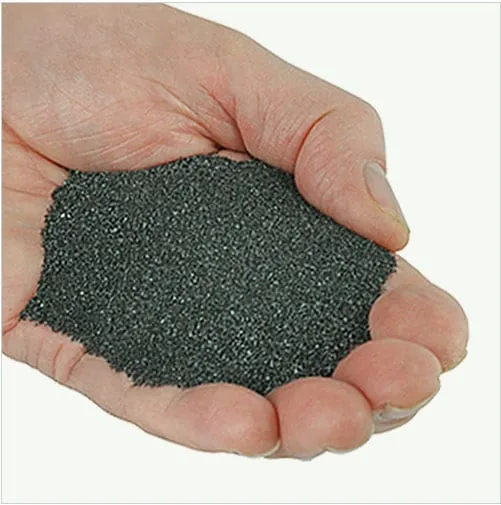
GreensandPlus, Birm and Ferrolite all reduce iron (Fe) and manganese (Mn), but they use different oxidants: GreensandPlus uses chlorine or another strong oxidant, Birm relies on dissolved oxygen and must not see free chlorine above 0.5 ppm, and Ferrolite works with chlorine dosing. The choice depends on pH, H₂S, Fe/Mn levels and backwash capacity. PT Watermart Perkasa supplies all three in Indonesia.
This article uses only data from the manufacturer datasheets cited in the sources line. Metric figures in brackets for Birm are our conversions from gpm/ft² and inches.
How do greensand, Birm and Ferrolite differ? Comparison table
| Parameter | GreensandPlus (Inversand) | Birm (Clack) | Ferrolite MC/GC (Tohkemy) |
|---|---|---|---|
| How it works | Manganese dioxide coated surface catalyses the oxidation-reduction of Fe and Mn; silica sand core | Insoluble catalyst that speeds the reaction between dissolved oxygen and iron; not consumed | Contact oxidation with chlorine dosing; the surface chemical acts as a catalyst and is continuously regenerated |
| Oxidant | Chlorine (Cl₂) or another strong oxidant, also potassium permanganate; 0.5–1.0 mg/L free chlorine residual in the filter effluent recommended | Dissolved oxygen of at least 15% of the iron and 29% of the manganese content; no regeneration chemicals | Chlorine or sodium hypochlorite; 0.3–0.5 mg/L free chlorine residual just after the filter described as most practical |
| Contaminants named by the maker | Fe, Mn, H₂S, arsenic, radium | Fe and/or Mn | High-concentration Fe and Mn in groundwater (and river water) |
| pH | 6.2–8.5; water below 6.2 corrected to 6.5–6.8 | 6.8–9.0; for Mn 8.0–9.0, and below 8.5 if Fe is present | Preferably above 6.5 |
| Feed-water limits | Chlorine demand ≈ 1×Fe + 3×Mn + 6×H₂S + 8×NH₃ (mg/L) | Free chlorine < 0.5 ppm; H₂S removed first; no oil or polyphosphate; TOC < 5 ppm; alkalinity > 2× (sulfate + chloride) | Theoretical chlorine 0.64×Fe or 1.29×Mn, more with organics, ammonia or reducing substances |
| Service flow | 2–12 gpm/ft² (4.9–29.4 m/h) | 3.5–5 gpm/ft² (≈ 8.6–12.2 m/h) | 10–30 m/h |
| Bed depth | 30 in. (762 mm) alone; 15 in. (381 mm) of each media in dual media; suggested anthracite 15–18 in. + GreensandPlus 15–24 in. | 30–36 in. (≈ 76–91 cm); freeboard at least 50% of bed depth | About 1.2 m |
| Backwash | Minimum 12 gpm/ft² at 55°F (29.4 m/h at 12.78°C) for 40% expansion; until clear or 10 minutes | 10–12 gpm/ft² (≈ 24.4–29.3 m/h); 20–40% expansion | No figure; GC described as expanding well so less wash water is needed |
| Grain size and density | Effective size 0.30–0.35 mm; 18x60 mesh; 1410 kg/m³ | Effective size 0.48 mm; 12x50 mesh; bulk density 36–38 lb/ft³ | MC1 1.2–2.0 mm, MC2 0.6–1.2 mm, MC3 0.3–0.65 mm; GC1 1.4–2.3 mm, GC2 0.6–1.4 mm; apparent SG MC 1.0–1.2, GC 0.65–0.75 |
| Temperature | No limit | 35–100°F (≈ 2–38°C) | Not stated |
| Start-up | Backwash, then condition with chlorine solution for at least 4 hours | No chemical regeneration stated | Activation described as easy and quick |
Sources: GreensandPlus Technical Data Sheet, Inversand Rev. 5/25; Clack Birm, Form No. 2350 and the Birm product page; Tohkemy Ferrolite HC/GC and the Tohkemy filter media catalogue. All accessed 12 November 2026. Manufacturer figures are design conditions, not guaranteed results on every water source.
When should you choose GreensandPlus?
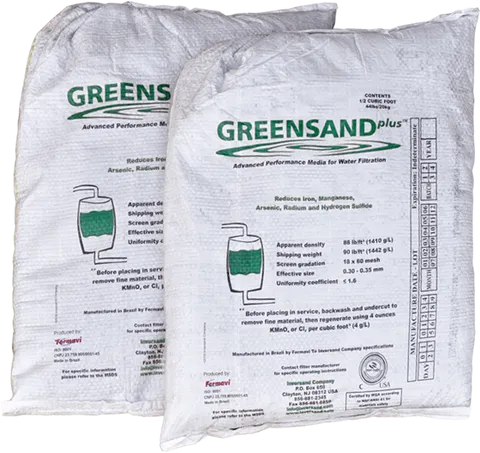
Consider GreensandPlus when the water contains H₂S as well as Fe and Mn, when the design already doses chlorine or another oxidant ahead of the filter, or when an old manganese greensand bed is being replaced. Inversand describes GreensandPlus as an exact replacement for manganese greensand with no change in backwash rate or time. The datasheet also gives a worked example: water with 1.7 mg/L Fe and 0.3 mg/L Mn at 4 gpm/ft² needs backwashing roughly every 32–38 hours of operation. Arsenic and radium only drop when iron (for arsenic) or manganese (for radium) is present, and the maker recommends pilot testing.
When should you choose Birm?
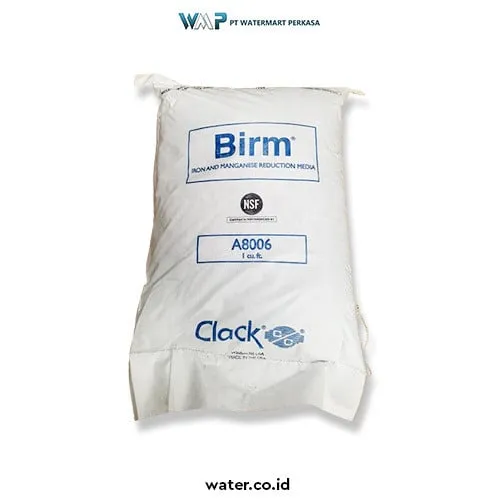
Birm suits water with no H₂S, oil, polyphosphate or free chlorine above 0.5 ppm, a pH of 6.8 or more, and enough dissolved oxygen. Clack notes that low-pH water can be raised first with Corosex, calcite or soda ash, and water low in dissolved oxygen can be aerated. Its main advantage: no regeneration chemicals, only periodic backwashing. Chlorination greatly reduces Birm’s activity.
When should you choose Ferrolite?
Tohkemy developed Ferrolite MC/GC mainly for high iron and manganese in groundwater, with chlorine preferably injected well upstream of the filter so it mixes fully. The MC series can be used in dual media with anthracite; the lighter GC series saves backwash water. For very high Fe and Mn, the Tohkemy catalogue suggests two vessels in series: Toyolex F (air oxidation) first and Ferrolite second. The 10–30 m/h range depends on turbidity, Fe, Mn, humic acid and silica; higher rates need a deeper bed.
How do you choose between them?
| Water and system condition | Direction to check |
|---|---|
| H₂S or rotten-egg odour present | GreensandPlus with an oxidant; Birm does not fit because H₂S must be removed first |
| No chlorine dosing wanted, pH ≥ 6.8, enough dissolved oxygen | Birm |
| Chlorination already ahead of the filter | GreensandPlus or Ferrolite; avoid Birm above 0.5 ppm free chlorine |
| pH below 6.2–6.5 | Correct pH first; maker minimums are 6.2 (GreensandPlus), 6.5 (Ferrolite), 6.8 (Birm) |
| Very high Fe and Mn | Ferrolite, a two-vessel system, or GreensandPlus with calculated capacity and backwash frequency |
| Limited backwash pump | Compare backwash needs: Birm 10–12 gpm/ft², GreensandPlus at least 12 gpm/ft²; Ferrolite GC described as saving wash water |
| Manganese is the main target | Birm needs pH 8.0–9.0 for Mn; GreensandPlus and Ferrolite use an oxidant |
Before choosing, test the raw water: total and dissolved Fe, Mn, pH, H₂S, dissolved oxygen, alkalinity, TOC or organics, ammonia, turbidity and residual chlorine. For laboratory testing, see lab.id.
Which media does Watermart supply?
PT Watermart Perkasa supplies all three media and the filter components around them:
- GreensandPlus (Inversand): full operating data and quote checklist.
- Clack Birm, plus Clack pH-raising media such as Corosex and calcite on the Clack media page.
- Ferrolite and other Tohkemy media.
- Iron and manganese filter media: summary and data to send.
- FRP tanks and control valves for filter vessels.
For a quote, send water test results, flow, tank diameter, backwash capacity and number of units through the Watermart contact page. If you need an assembled filter system, our sister company PT Beta Pramesti Asia handles systems and projects at beta.co.id.
FAQ about greensand, Birm and Ferrolite
Can Birm be used with chlorine?
Not recommended. The Clack datasheet limits free chlorine in feed and backwash water to below 0.5 ppm and states that chlorination greatly reduces Birm’s activity.
Does GreensandPlus have to be regenerated with potassium permanganate?
No. The Inversand datasheet describes catalytic oxidation with chlorine or another strong oxidant, with permanganate, or with chlorine plus permanganate. The oxidant residual carried through the filter keeps the media continuously regenerated.
Which media removes H₂S?
Of the three, only the GreensandPlus datasheet names H₂S as a contaminant it removes. The Birm datasheet requires H₂S to be removed before the water contacts the media.
What is the minimum pH for each media?
GreensandPlus 6.2 (lower water corrected to 6.5–6.8), Ferrolite preferably above 6.5, and Birm 6.8. For manganese, Birm needs pH 8.0–9.0.
Can an old manganese greensand bed be replaced with GreensandPlus?
Inversand describes GreensandPlus as an exact replacement for manganese greensand, with no change in backwash rate, time or chemical feed. Still check the distributor, bed depth and backwash capacity of the existing filter.