
Ion Exchange Resin
TRILITE Resin Distributor for Indonesia
TRILITE resin supplier in Indonesia for softening, demineralisation, and sugar decolorisation. Compare KC-08, KH-80, and ASP10 by water or liquor data and regeneration.
TRILITE KC-08 and KH-80 resin distributor in Indonesia
PT Watermart Perkasa, based in Jakarta, supplies TRILITE KC-08 and KH-80 resin for water softening and demineralisation in Indonesia, and TRILITE resin for sugar-liquor decolorisation in sugar refineries. Before requesting a quotation, match the resin type to the water analysis or liquor data, allowable ion leakage or colour target, bed volume, flow, vessel-and-valve configuration, regenerant, and operating conditions.
Updated 12 November 2026: a sugar-decolorisation resin section and buyer FAQ were added; the softening and demineralisation guidance is unchanged.
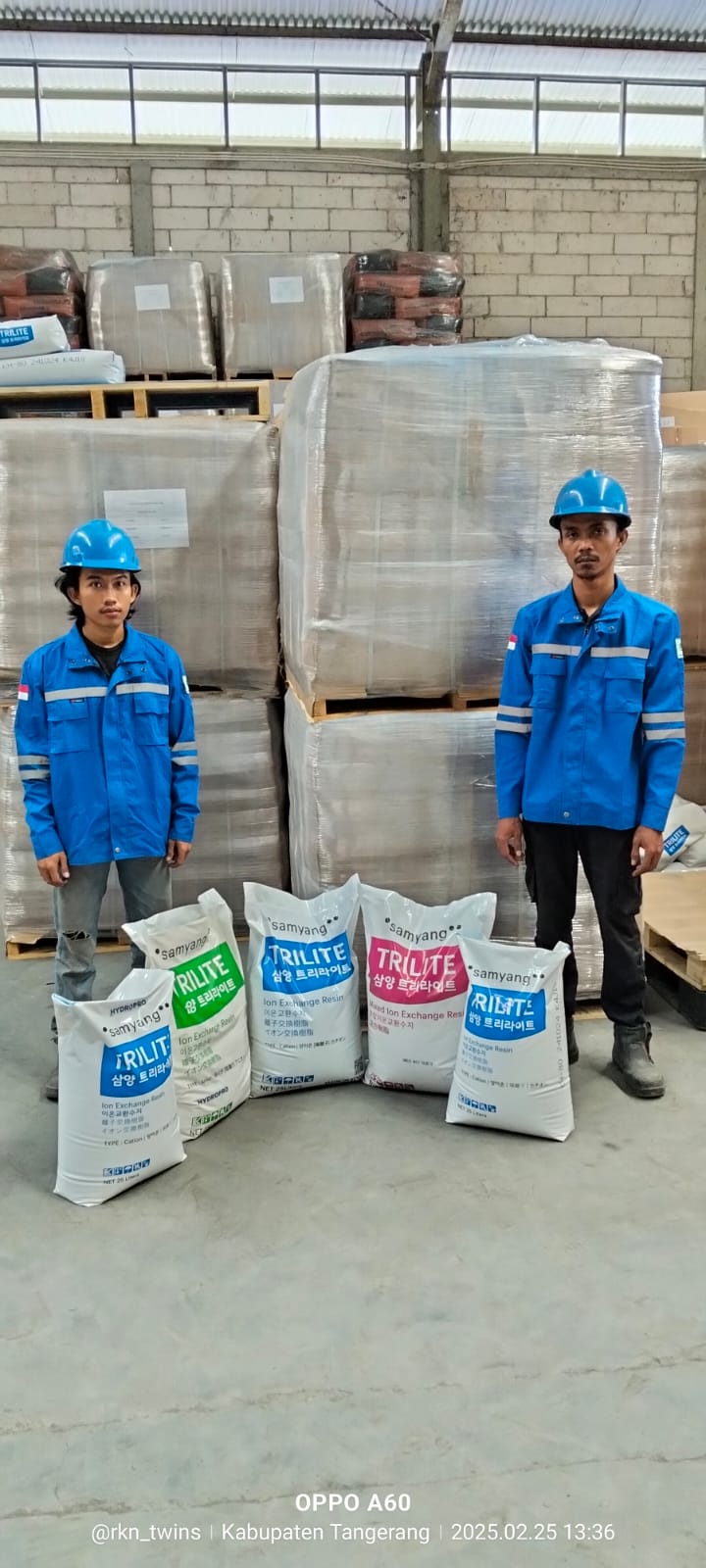
TRILITE KC-08 and KH-80 are strong-acid cation exchange resins. Assess each option from the current product data and system design, not the series name alone. For softening, check inlet hardness and the allowable hardness leakage; for demineralisation, check the cation-anion arrangement, conductivity target, regeneration, and polishing requirement.
| Buyer requirement | Data to provide | Next page |
|---|---|---|
| Replace softener resin | Old model, resin volume, hardness, flow, valve, and salt consumption | Water-softening application |
| Cation resin for demineralisation | Ion analysis, conductivity target, vessel arrangement, and regenerant | Ion-exchange resin options |
| Retrofit an existing system | Label photo, vessel dimensions, freeboard, internal distributor, and operating problem | Watermart contact form |
For food, beverage, pharmaceutical, or halal-controlled processes, use the TRILITE halal-document and lot-traceability checklist before purchase-order release, receipt, and commissioning.
TRILITE® Strong Cation Exchange Resin Advantages
- High ion exchange capacity for hardness and dissolved metal removal
- Chemical stability within the operating limits in the product data
- Non-flammable and non-hazardous, safe for handling and storage
- Thermal robustness: remains stable at high operating temperatures
- Granular solid, easy to handle and minimal dust formation
Technical Specifications of TRILITE® KC-08
| Parameter | TRILITE® KC-08 |
|---|---|
| Chemical Type | Strong acid cation exchange resin |
| Physical State | Solid (granular) at 20°C |
| Main Ingredient | Diethenylbenzene polymer (sulfonated sodium salt) |
| CAS Number | 69011-22-9 |
| Water Content | 53 ± 5% |
| Polymer Content | 47 ± 5% |
| pH Range (at 20°C, in H₂O 1:5) | 6.8 - 7.8 |
| Melting Point | > 80°C |
| Water Solubility | Insoluble at 20°C |
| Density (20°C) | 1.3 |
| Flash Point | No flash below 93°C |
| Autoinitiation Temperature | None below 200°C |
| NFPA Health/Fire/Reactivity/Water | 0/1/0/0 |
| Toxicity/Environmental Effects | Not classified as toxic or hazardous |
For full details, please download the official document: [Download EN_MSDS_TRILITE KC-08](/hubfs/waterpdfs/trilite_files/EN_MSDS_TRILITE KC-08.pdf)
Technical Specifications TRILITE® KH-80
| Property | Value / Description |
|---|---|
| Product Type | Strong Acid Cation Exchange Resin |
| Physical State | Solid (Granular) at 20°C |
| pH (1:5 H₂O) | 6.8 ~ 7.8 at 20°C |
| Melting/Freezing Point | > 80°C |
| Density | 1.3 at 20°C |
| Water Solubility | Insoluble at 20°C |
| Flash Point | No flash occurred under 93°C |
| Autoinition Temperature | No spontaneous combustion under 200°C |
| Major Composition | Diethenylbenzene Polymer with Ethylbenzene, Sulfonated, Sodium Salts (46±5%), Water (54±5%) |
For more information, please download the official document: [Download EN_MSDS_TRILITE KH-80](/hubfs/waterpdfs/trilite_files/EN_MSDS_TRILITE KH-80.pdf)
Main Applications of TRILITE® KC-08 & KH-80 Resins
- Water Softening: Removes calcium and magnesium ions to prevent scale formation in piping systems and industrial equipment.
- Demineralization: Lowers dissolved mineral content to produce high purity water, suitable for boilers, cooling towers and sensitive industrial processes.
- Drinking Water Treatment: May form part of a process for reducing selected ions when the resin, regeneration, sanitation, and complete system are designed for the treated-water target.
- Wastewater Purification: Used in wastewater treatment systems to reduce pollutants before discharge into the environment.
Which TRILITE resins are used for sugar decolorisation?
Resin decolorisation of sugar uses macroporous anion resins in the chloride form that hold negatively charged colourants from the sugar liquor and are regenerated with brine. In the TRILITE range, the Watermart TRILITE guide lists ASP10, an acrylic macroporous strong-base anion resin for colour reduction in highly coloured sugar solutions, and AMP14, a styrenic macroporous anion resin for organic scavenging and sugar purification. Both differ from KC-08 and KH-80, which are cation resins for water.
Purolite’s technical notes on cane-sugar colourants and decolorisation describe a general principle that also applies when comparing other brands: acrylic resins are slightly less selective for colourants but can be fully regenerated with sodium chloride, while styrenic resins have higher decolorising capacity but foul more easily with organics. Many plants place the acrylic resin first to hold large colour molecules and use the styrenic resin as a polisher.
| Liquor condition | Resin path discussed | Data to send |
|---|---|---|
| High or fluctuating inlet colour | Acrylic macroporous anion resin, for example TRILITE ASP10 | Inlet and target colour (ICUMSA), Brix, temperature, pH, flow, and the process upstream of the resin columns |
| Polishing to a low product colour | Styrenic macroporous anion resin, for example TRILITE AMP14, after the acrylic stage | Colour after the first stage, product colour target, bed volume, and column arrangement |
| Replacing resin in existing columns | The same model and ionic form, or a documented equivalent | Existing resin code, volume per column, service life, brine or brine-caustic regeneration pattern, and capacity per cycle |
Model availability, packing, Halal or food-contact documents, and the datasheet revision are confirmed per product code at quotation. Column configuration, operating temperature, and the regeneration programme are set by the sugar plant’s process designer, not by this table. For process-water treatment in a sugar plant, use the ion exchange resin hub.
Competitive Advantages of TRILITE® Products
- Ion Exchange Performance: Working capacity and ion leakage must be calculated from water quality, regeneration, and operating conditions.
- Chemical Stability: Check oxidant, temperature, pH, and regenerant limits in the current product data and SDS.
- Handling: Follow the current SDS for PPE, storage, spills, and resin disposal.
- Ease of Handling & Storage: Solid granular form, minimal dust, and easy to apply in the field.
- Regulation & Transportation: Not classified as dangerous goods, free of restrictions on land, sea, and air shipments.
Safe Handling and Storage Instructions
Handling
- Avoid inhaling resin dust.
- Ensure adequate ventilation in the work area, especially when handling large quantities.
- Use personal protective equipment (PPE) such as dust masks, chemical gloves, and safety glasses.
Storage
- Store in tightly closed containers.
- Avoid exposure to direct sunlight, heat sources and strong oxidizing agents.
- Ensure the storage area is dry and well ventilated.
Emergency Measures & First Aid
First Aid
- Eye Contact: Rinse with running water for 15 minutes, consult a doctor if irritation persists.
- Skin Contact: Wash with soap and clean water.
- Inhalation: Move to an area with fresh air, seek medical attention if needed.
- Ingestion: Rinse mouth, do not induce vomiting, consult a doctor immediately.
Fire Fighting
- Use extinguishing media such as water spray, dry chemical, alcohol-resistant foam, or carbon dioxide.
- Use self-contained breathing apparatus if necessary.
- No flash point below 93°C, not flammable.
Regulatory & Transportation Information
- Not classified as dangerous goods according to UN TDG, OSHA, or Korean regulations.
- Follow the classification and environmental instructions in the current SDS and applicable local disposal rules.
- Free of land, sea, and air shipping restrictions.
Waste Disposal Procedure
- Dispose of resin waste according to local environmental regulations.
- Use sealed and leak-proof containers for resin waste and contaminated packaging.
Why Choose TRILITE® from PT Watermart Perkasa?
- Indonesian Supplier: PT Watermart Perkasa supplies TRILITE resin for projects in Indonesia.
- Procurement Check: Model, quantity, documents, availability, and lead time are confirmed during quotation.
- Technical Support: Our technical team is ready to assist with application consultation and selection of the right product for your water treatment system needs.
Download Official Documents & Additional Information
- [Download EN_MSDS_TRILITE KC-08](/hubfs/waterpdfs/trilite_files/EN_MSDS_TRILITE KC-08.pdf)
- [Download EN_MSDS_TRILITE KH-80](/hubfs/waterpdfs/trilite_files/EN_MSDS_TRILITE KH-80.pdf)
Contact PT Watermart Perkasa for Consultation & Ordering
PT Watermart Perkasa supplies ion-exchange resin for industrial, commercial, and utility water-treatment systems. Provide the model, quantity, water analysis, bed volume, flow, regenerant, vessel, valve, project location, and required date so the TRILITE KC-08 or KH-80 option can be checked.
Send the project data through the Watermart contact form for technical consultation, a quotation, or a check of the applicable TRILITE resin documents.
TRILITE resin FAQ
Who supplies TRILITE resin in Indonesia?
PT Watermart Perkasa in Jakarta supplies TRILITE resin for softening, demineralisation, and sugar decolorisation. Model, quantity, documents, availability, and lead time are confirmed in writing at quotation.
How do TRILITE KC-08 and KH-80 differ from ASP10?
KC-08 and KH-80 are strong-acid cation resins that exchange hardness and other cations in water. ASP10 is an acrylic macroporous anion resin listed for colour reduction in sugar solutions. They do different jobs and cannot replace each other.
What data is needed for a sugar-decolorisation resin quotation?
Send inlet and target liquor colour in ICUMSA, Brix, temperature, pH, flow, number and volume of columns, the installed resin code, regeneration pattern, packing, quantity, plant location, and required date through the Watermart contact form.
Does TRILITE resin alone make water ready to drink?
No. Drinking-water suitability must be demonstrated against applicable Indonesian requirements through a complete process design, commissioning, sanitation, controlled regeneration, consumables records, representative sampling, and laboratory verification.